I’ve enjoyed reading John Mark Comer’s book Practising the Way, and his core message (cultivate a rule of life based on a set of practises that help you to be with Jesus, become like him, and do as he did) feels deeply resonant with what the OMS is all about.
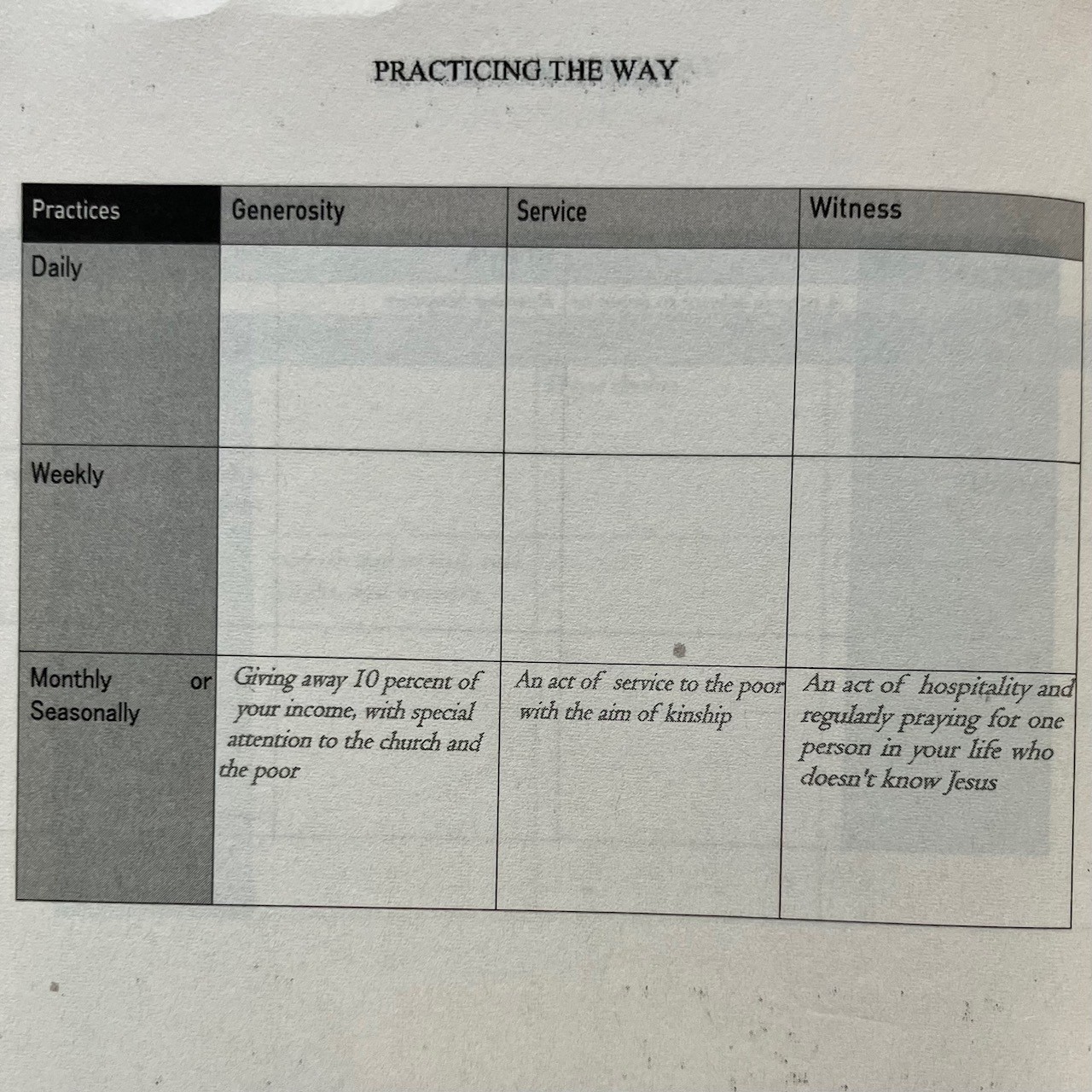
There was however one section of the book which drew a wry smile. Towards the back he offers a tool for developing a rule of life, which consists of an empty grid with a set of practises along the top and frequencies (daily, weekly, monthly) down the side. The idea is that you fill the grid up with a set of actions which embody the practises across the different timescales of life. It made me smile because this tool was exactly how I started my own OMS journey 20 years ago, but now refer to as the ‘grid of doom’.
Why doom? Because it suggests a goal (“fill every box”) which turns out to be a recipe for failure and disappointment. Completing the grid either loads us with an impossible burden to carry, or deceives us into thinking that we can earn God’s approval through our efforts. Of course this wasn’t why I originally used it and it absolutely isn’t what John Mark Comer is suggesting. But there is something about human nature which means that we always seem to fall into one trap or the other.
My own version of a personal customary has changed many times over the last 2 decades. The next attempt was a more organic mind-map, which at least dealt with the perception that I could or should ‘fill in all the boxes’. From there I moved to an agricultural image, seeing each practise as a field and exploring whether it was in a season of ploughing the ground, planting new seeds, growth, fruitful harvest, or resting fallow. My current version is a rock band, and calls out the drumbeats of foundational disciplines, the regular bassline rhythms, the lead vocals of present calling and vocation, the backing vocals and keyboards which support the melody, and the lead guitar riffs that break in with fresh energy. I’m sure that this won’t be the last word either, as the scope for creativity is almost unlimited.
So where does this leave the grid? I do still think it makes a good tool for review and reflection, and I sometimes use it to identify all of the good stuff that God has planted and grown in my life over months and years. It brings me to a place of encouragement and thankfulness, and reminds me that I don’t always need to find a bunch of new things to add to the list, just remain faithful in where God is leading. But I’m grateful to have been released from the self-imposed tyranny of filling all of those empty boxes.
Image: “Practicing the Way”, John Mark Comer